
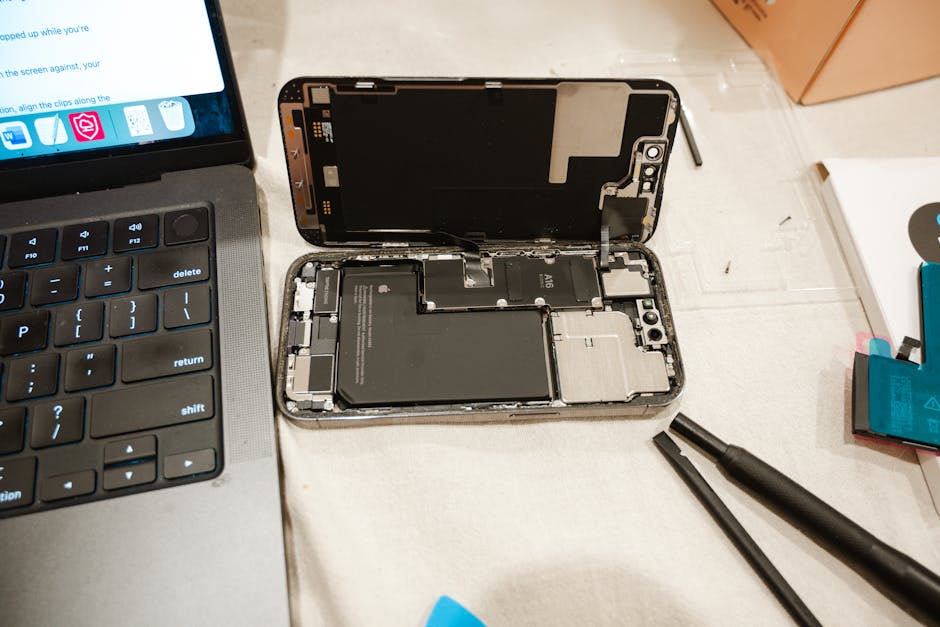
Most people replace their phone's battery either way too early ("it feels slow") or way too late ("it dies at 4 PM and I'm just used to it"). Apple, Samsung, and Google all agree on a single number that decides the call. It's not how old the phone is.
The 80% rule
A battery at 80% of its original capacity is the threshold where a replacement actually changes your day. Below 80% you'll notice; above 80% you probably won't. Apple's "Service" recommendation in Battery Health kicks in at exactly this number. iOS, OneUI, and Pixel firmware all expose it — Settings → Battery → Battery Health on iOS, Settings → Battery on Pixel, similar on Samsung.
The 80% number isn't arbitrary. Lithium-ion batteries lose capacity in a curve that's gentle at first and steepens as it goes. From 100% to 90% you barely notice. 90% to 80% gets noticeable on long days. Below 80% you'll think about your charger every afternoon.
What actually kills batteries faster than time
Heat is the biggest factor. A phone left in a hot car on an afternoon ages the battery the equivalent of months of normal use. The Tensor G3 (Pixel 8) and the A17 Pro (iPhone 15 Pro) both run warmer than their predecessors, which is why their batteries degrade slightly faster.
Persistent fast-charging at 100% is second. The brick stays plugged in overnight even though the phone is full; the battery sits at full voltage for hours. Optimized Battery Charging (iOS) and Adaptive Charging (Pixel) exist for exactly this reason — they keep the battery away from 100% until the alarm.
Cycling between 0% and 100% is third. Partial cycles between 20% and 80% are gentler than full cycles. Apple's Optimized Battery Charging — on by default — addresses this by pausing the charge near 80% and finishing only just before your usual unplug time. On iPhone 15 and newer, the Charge Limit setting (Settings → Battery → Charging) lets you go a step further and cap charging at 80–95% all the time. It's the same idea: keep the cell away from sustained high voltage.
When a replacement actually helps
The honest answer:
- Below 80%: replacement is almost always worth it. Noticeable, almost-new-phone-feeling improvement.
- Between 80% and 90%: only if the phone is your only one and you do long days away from a charger.
- Above 90%: no.
A new battery on a phone with 78% health is a transformation. A new battery on a phone with 92% health is an expensive placebo. People often pay for the placebo because the phone "feels slow" — slowness is rarely the battery; it's usually a software state that a restore-from-backup or a settings reset fixes for free.
Costs
Phone batteries are 30 to 60 minutes while you wait; MacBooks are 1 to 2 days. Manufacturer warranty doesn't cover degradation past one year on most devices, so by year two you're paying out of pocket regardless. For the current price on your specific model, see the live quote on its repair page.
When it's worth bringing in
Walk in with the device unlocked enough that we can read Battery Health on the spot. We'll show you the number, tell you what we'd do in your shoes, and quote the swap before opening anything. If the number is above 85% and you're under three years on the device, we'll usually tell you to come back in a year. We don't make money replacing batteries that don't need replacing.
Walk-ins are welcome at both locations during business hours, no appointment needed. Every battery replacement is backed by our 90-day warranty.